
There is a certain type of hunter who shows up at the ramp before anyone else, not because he woke up earlier, but because he spent the last two weeks doing things the other guys in the parking lot have never considered.
He has satellite imagery of the marsh saved to his phone. He has been tracking water levels on the USGS gauge for the past month. He knows the wind forecast for the next three days down to the hour, and he has already adjusted his spread placement twice based on what he read last night. He is not the loudest guy at the camp. But he is consistently the most successful.
The best hunters have always been the best students of their environment. What has changed is the quality of the tools available to study it.
Scouting Has Gone Digital
Ten years ago, scouting a new piece of water meant physically driving to it, walking the banks, and making educated guesses about where birds would be based on what you could see from the shore. That information was valuable, but it was limited by what you could observe with your own eyes.
Today, a serious hunter can pull up satellite imagery on Google Earth and identify submerged vegetation beds, water depth changes, and natural funnel points without leaving his truck. Apps like onX Hunt and HuntWise overlay public land boundaries, historical migration data, and weather patterns on top of that satellite imagery. The USGS National Water Information System provides real-time water level data for rivers and marshes across the country.
This is not cheating. This is preparation. The birds are still wild, the weather is still unpredictable, and the outcome is never guaranteed. But the hunter who walks into a new piece of water with three weeks of digital research behind him is going to outperform the one who showed up on a gut feeling.
The Technology in Your Spread
The decoy spread has always been the primary tool of the waterfowl hunter. For most of the twentieth century, that meant wooden or plastic blocks arranged in a pattern designed to look like a resting flock. The spread was entirely static, relying on visual realism alone to convince incoming birds to commit.
The introduction of motion into the spread changed everything. The first spinning-wing decoys in the late 1990s demonstrated definitively that movement was the missing variable. Birds that would circle a static spread without committing would lock up and finish to a spread with a single moving element.
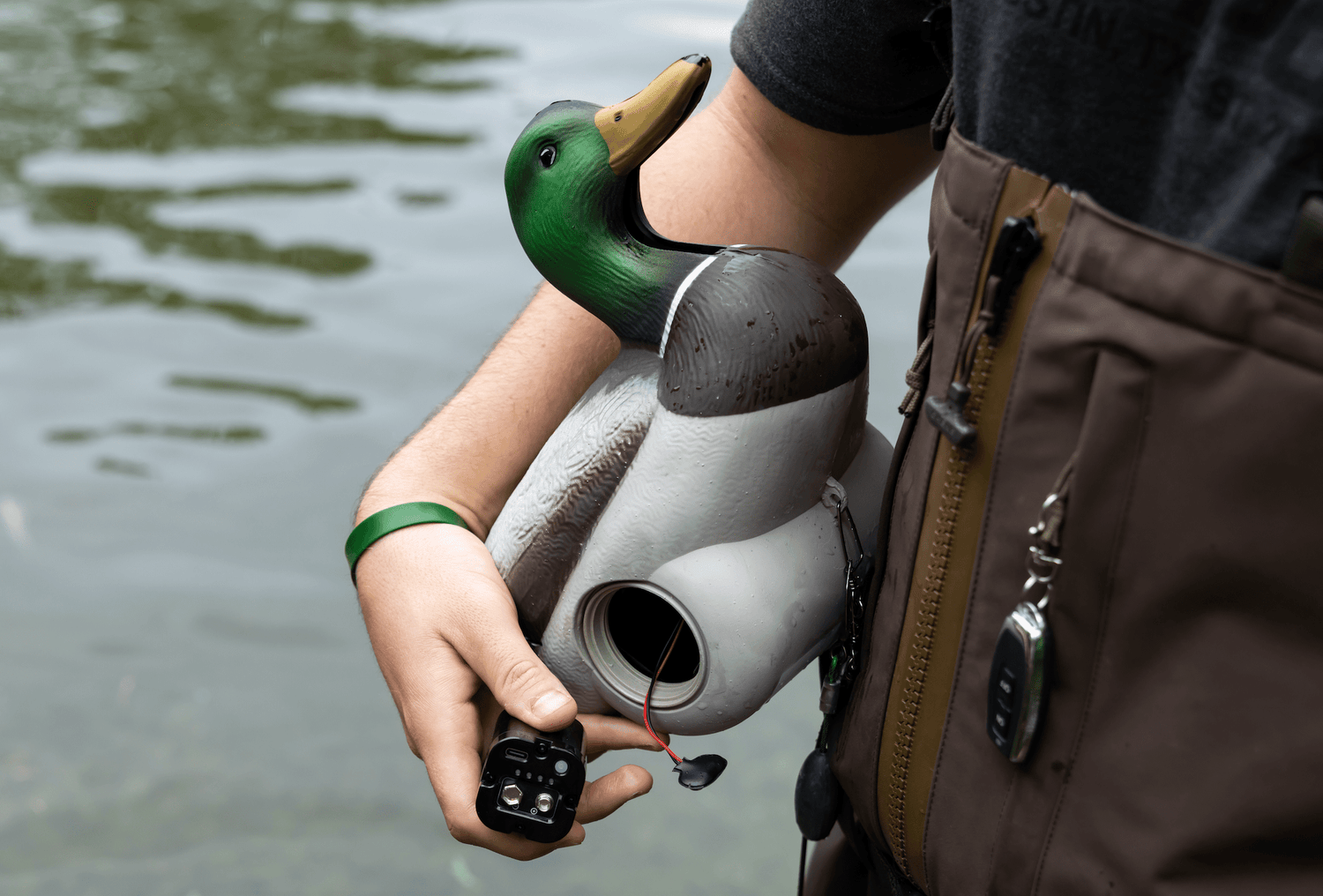
The technology has continued to evolve. Today, motion duck decoys have moved well beyond the spinning wing — full-body swimming designs like the Flyway Deputy represent the current leading edge of that evolution. Rather than simulating a single wing-flapping motion, a swimming decoy creates the full-body movement of a live bird feeding on the surface. The remote control capability allows the hunter to activate or deactivate the motion based on what the birds are doing—a feature that matters more than most hunters realize. There are mornings when motion pulls birds in, and there are mornings when birds are already committed and additional motion will flare them. The ability to control that variable from the blind is a genuine tactical advantage.
The Gear That Earns Its Price
The high-end outdoor market has expanded significantly over the past decade, and for good reason. The gap between quality tiers in hunting gear is real and measurable.
A premium wader built with Gore-Tex Pro will outperform a budget wader in cold water conditions in ways that become immediately apparent when you are standing in forty-degree water for six hours. A quality shotgun with a well-fitted stock will consistently outperform a budget option when you are shooting in cold weather with heavy gloves. The investment in quality gear is not about status. It is about performance in conditions that punish inferior equipment.
The same logic applies to technology. Motion duck decoys that fail on the third morning of the season are not a bargain at any price. The hunter who invests in reliable, well-engineered gear spends less time troubleshooting and more time hunting.
The Edge Is in the Details
The hunters who consistently fill limits are not doing one thing dramatically better than everyone else. They are doing a hundred small things slightly better. They are on the right piece of water because they scouted it properly. Their spread looks alive because they understand how motion duck decoys change the equation. Their gear functions reliably because they invested in quality and maintain it well.
Technology does not replace woodsmanship. Reading the birds, understanding the wind, and knowing when to call and when to stay quiet are skills that no app can replicate. But technology amplifies the fundamentals. It gives the prepared hunter better information, better tools, and a better chance at a successful outcome.
The best hunters in the room are gear nerds because they understand that the details matter. Every advantage is worth pursuing.
0 comments